Most SMT placement tasks are straightforward when the component has a flat, accessible surface and the correct standard nozzle is available. The nozzle contacts the component, vacuum is applied, and the machine can pick, move, recognize, rotate, and place the part.
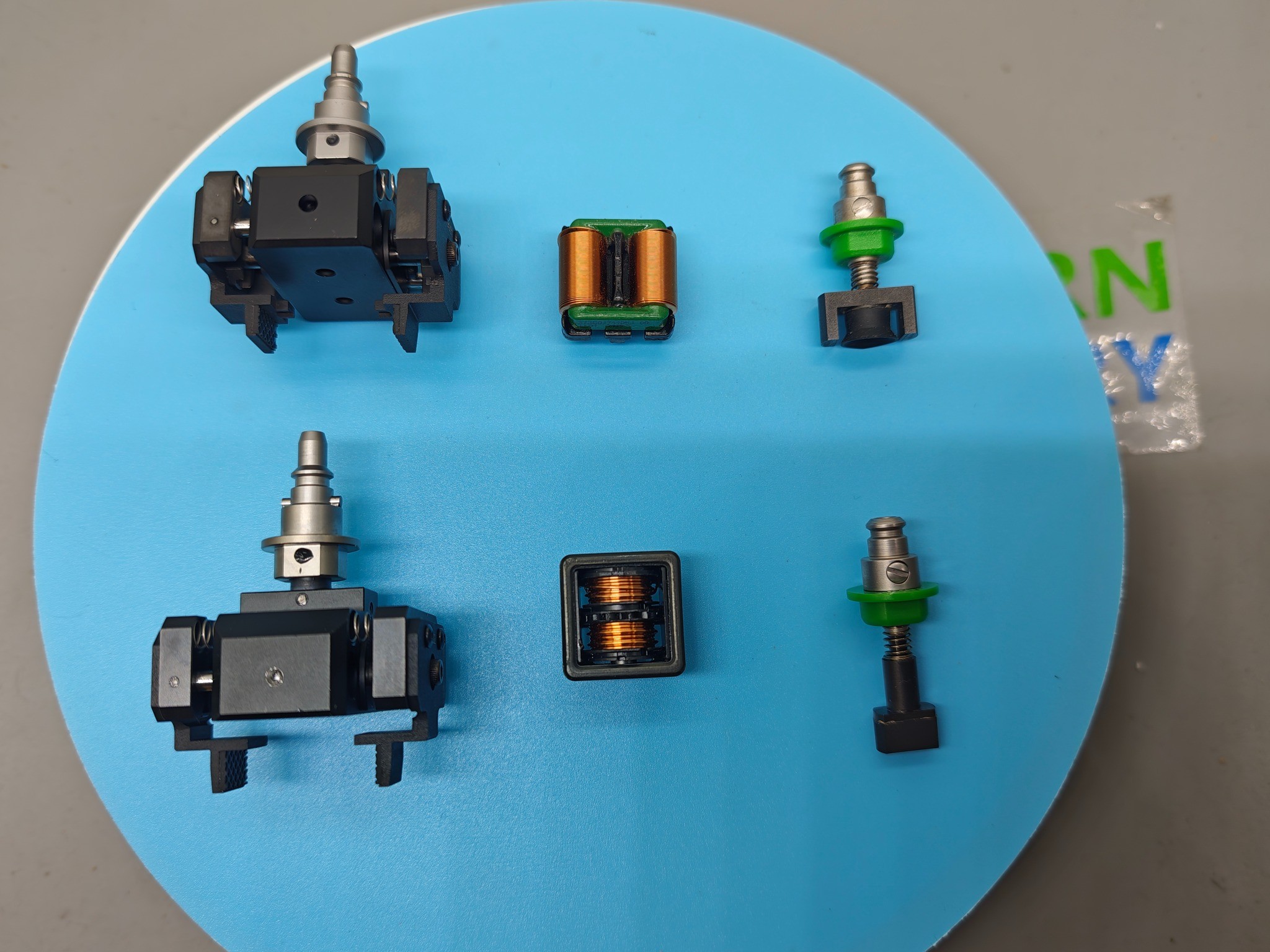
The situation changes when the component is large, heavy, uneven, fragile, or simply not designed with a stable vacuum pickup area. Coils, magnetic components, connectors, relays, transformers, shielding parts, sensors, and other odd-shaped components may require a different engineering approach.
The right question is not always “Which standard nozzle should we use?” Sometimes it is “Is vacuum pickup still the right method for this component?”
Why Component Geometry Matters
The nozzle is the physical interface between the placement machine and the component. For vacuum pickup to remain stable, the contact area, air seal, component balance, acceleration, and movement all matter. A nozzle that can lift a component once on a bench is not automatically a reliable production solution.

In this example, the component is a line choke used in a power-electronics application. Several handling challenges become clear:
- The upper surface is interrupted by wound copper coils and structural gaps.
- The leads project from the body and must be protected from unintended contact.
- The component offers limited continuous surface area for a conventional vacuum seal.
- The best pickup or gripping position must control the component without damaging sensitive structures.
Why Uneven Surfaces Can Make Vacuum Pickup Difficult
A vacuum nozzle needs to create and maintain a pressure difference between the nozzle and the contact surface. If that surface is interrupted by gaps, contours, grooves, or porous structures, air leakage can reduce the available holding force.
A component may still be lifted during a static trial, yet become unstable when the machine accelerates, changes direction, rotates the component, or moves toward the placement position. Pickup reliability therefore needs to be evaluated dynamically, not only by checking whether the part can be lifted once.
Before Customizing Diagnose the Whole Pickup System
A difficult pickup does not automatically mean the nozzle is the problem. Before designing custom tooling, check the complete handling chain:
- Is the component presented consistently by the feeder or tray?
- Is pickup height correct and repeatable?
- Is the vacuum level sufficient and stable?
- Is the nozzle centered on a mechanically stable area?
- Does the component tilt, rotate, or move before pickup?
- Are vision settings, orientation, and placement parameters correct?
If these process variables are controlled and the geometry still provides no reliable suction surface, a customized pickup method becomes more relevant.
When a Mechanical Gripper Nozzle Makes Sense
A clamp-type or gripper nozzle changes the pickup principle. Instead of depending only on suction from the top surface, mechanical jaws contact selected areas on the sides or body of the component. This shifts the engineering task from finding a suction area to finding a safe and repeatable gripping area.

A successful gripper design should establish safe jaw contact, sufficient approach clearance, suitable gripping travel and force, component balance during motion, and compatibility with the target machine interface.
Start With Measurement Not Assumptions

Photographs are useful, but dimensions are essential. The design package should include component length, width, height, weight, available pickup or gripping area, lead position, orientation, and the machine-side interface. A physical component sample or old nozzle can reveal details that are easy to miss in a drawing.
Component → Measurement → Pickup Analysis → Nozzle Design → Prototype → Pickup Test → Machine Validation
What a Simulated Pickup Test Can Prove

A simulated bench test can verify basic mechanical feasibility: the jaws can approach the component, close around the intended area, lift the part, maintain control during movement, and release it.
However, a bench demonstration is not full production validation. Machine-level testing is still required to evaluate repeatability, placement accuracy, cycle time, collision clearance, component recognition, long-term wear, and repeated-cycle performance.
Standard Nozzle Custom Vacuum Tip or Gripper
A standard nozzle remains the first choice when it provides reliable pickup. A customized vacuum tip may be appropriate when a usable suction area exists but the standard tip geometry is wrong. Multi-hole or soft-contact designs may help in other situations. Mechanical gripping becomes attractive when a stable vacuum surface is limited but safe side-gripping features are available.
The objective is to use the simplest tooling that achieves stable, repeatable, production-compatible handling.
FAQ About Custom SMT Nozzles
Does every coil or transformer need a gripper nozzle?
No. Many magnetic components can be handled with vacuum nozzles if they have an appropriate pickup surface. Consider a gripper only after evaluating the actual geometry, weight, process, and machine interface.
Can a custom nozzle be designed from a component sample?
Yes. A physical sample can identify candidate pickup or gripping zones. Machine information is still required so the custom tooling can be integrated correctly.
Is a successful manual pickup test enough for production?
No. It demonstrates mechanical feasibility. Production approval should follow machine-level validation and repeated-cycle testing under the intended operating conditions.
Have a Component That Is Difficult to Pick?
Send us component photos or a physical sample, dimensions and weight, machine brand and model, existing nozzle details, and a description or video of the pickup problem. We can evaluate whether a standard nozzle, customized vacuum nozzle, or mechanical gripper is more suitable.
Trademark note: JUKI is a trademark of its respective owner. References describe machine compatibility and application context and do not imply OEM manufacture or endorsement unless explicitly stated.