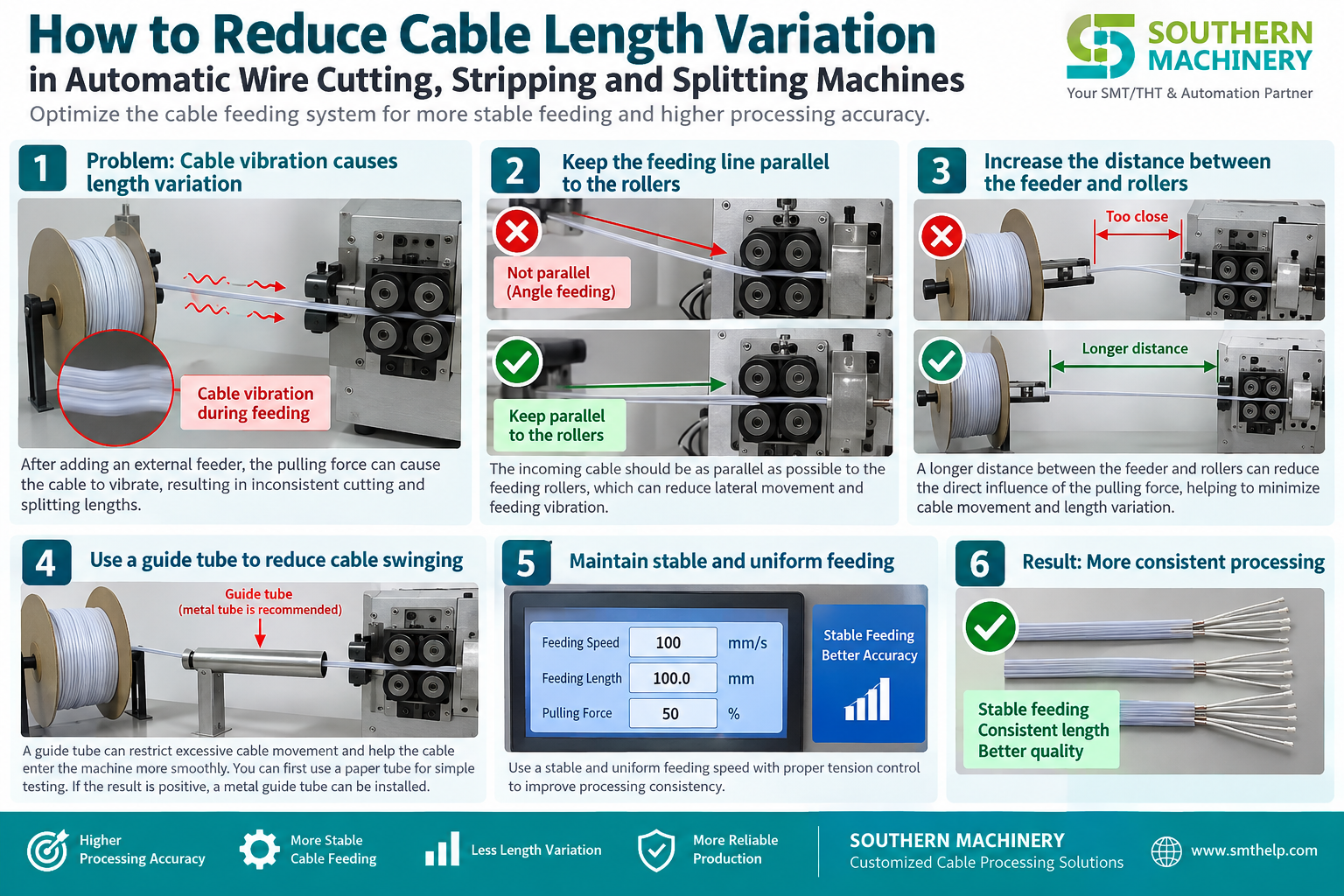
In automatic wire processing, cutting accuracy does not depend only on the cutting blade or machine parameters. The cable feeding system can also have a major impact on final processing consistency.
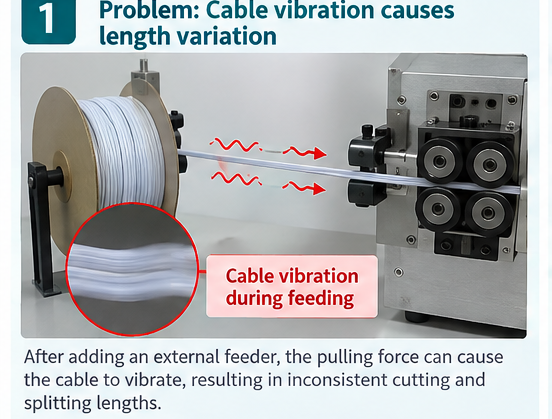
In one recent cable processing application, an external cable feeder was added before the machine. During feeding, the cable experienced pulling force and visible vibration. This unstable movement affected cable positioning and created length differences after cutting and splitting.
After reviewing the process with our engineering team, we identified several practical improvements that can be tested before redesigning the machine.
Why Cable Feeding Matters
The incoming cable must reach the machine in a controlled position and under reasonably stable tension. If it swings, enters at an angle, or is repeatedly pulled and released, the effective feed can vary even when the machine parameters remain unchanged.
1 Keep the Feeding Line Parallel to the Rollers
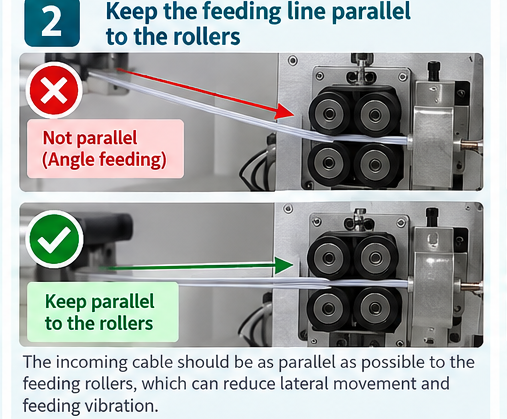
The first engineering recommendation is to keep the incoming cable as parallel as possible to the machine feeding rollers.
When the cable enters the rollers at an angle, part of the pulling force acts laterally instead of only in the feeding direction. This can increase swinging and vibration before the cable reaches the cutting or splitting position.
A straighter feeding path helps the rollers pull the cable more consistently and reduces unnecessary lateral movement.
2 Increase the Distance Between the Feeder and the Rollers
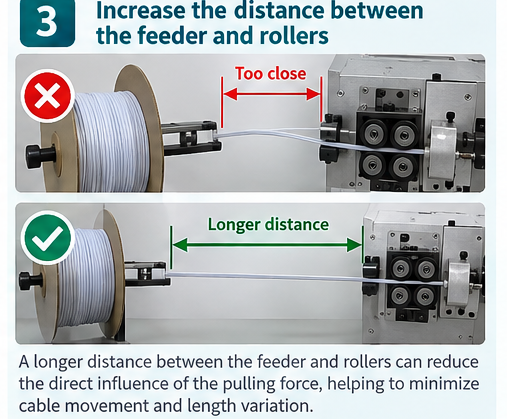
The second recommendation is to increase the distance between the external feeder and the machine feeding rollers.
If the feeder is positioned too close to the rollers, fluctuations in pulling force can be transferred directly to the cable entering the machine. A longer transition distance helps reduce the immediate influence of this force and gives the cable more space to stabilize before processing.
This is especially useful when the cable visibly shakes after the feeder starts pulling.
3 Use a Simple Guide Tube to Verify the Principle
Before making a permanent modification, a simple guide-tube test can be used to verify whether cable swinging is a major cause of the problem.
A quick test can be made by rolling a piece of paper into a tube and letting the cable pass through it before entering the machine. The temporary tube restricts the cable's movement range and can make the feeding path smoother.
If the test clearly improves stability, the paper tube can be replaced with a properly positioned metal guide tube as a simple feeding guide.
4 Maintain Stable and Uniform Feeding
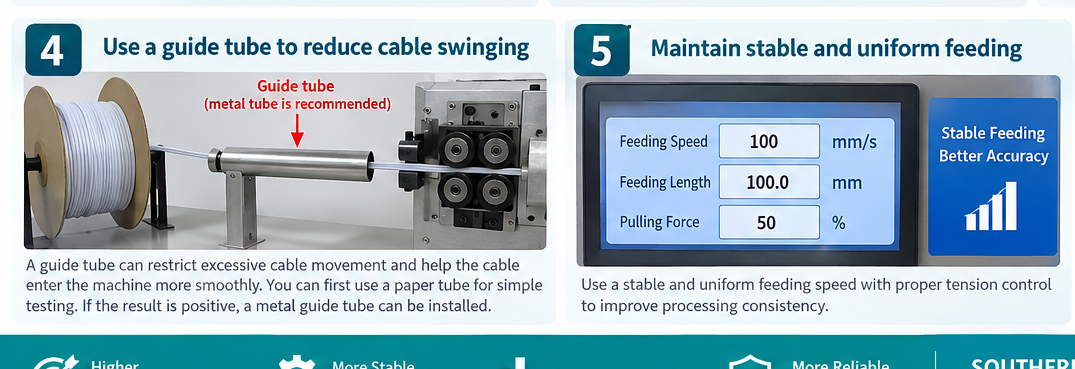
The final objective is not only to guide the cable mechanically, but also to keep the feeding speed and cable tension as stable as possible.
Repeated pulling and releasing can continuously change the tension on the cable. A more uniform feeding condition reduces vibration and helps improve cutting and splitting consistency.
Recommended Troubleshooting Sequence
- Check whether the incoming cable is parallel to the feeding rollers.
- Observe whether the cable swings, vibrates or changes tension during feeding.
- Increase the distance between the external feeder and machine rollers.
- Use a temporary paper guide tube to test whether restricting cable movement improves the result.
- If effective, install a properly positioned metal guide tube.
- Run repeated samples and compare the cutting and splitting lengths before and after each adjustment.
Why This Matters for Customized Cable Processing
For standard single wires, small feeding fluctuations may sometimes be manageable. For flat cables, ribbon cables and multi-conductor cables, however, stable positioning is more critical because the process may include cutting, stripping, splitting, tin dipping and terminal crimping.
If the cable position is unstable at the feeding stage, the error can continue into downstream operations. For this reason, the complete feeding and processing system should be evaluated as one integrated solution.
Sample Testing Is Still Important
Mechanical drawings and cable specifications are useful for preliminary design, but actual samples remain important for customized applications.
Cable flexibility, surface material, conductor structure, width, thickness, friction, reel tension and required split length can all change the real processing behavior. Sample testing is therefore recommended before finalizing customized tooling and production parameters.
Customized Wire Processing Solutions
Southern Machinery supports customized cable processing applications including automatic cutting, stripping, ribbon cable splitting, customized cable guides and fixtures, cutting and stripping blades, tin dipping, terminal crimping, feeding optimization and process validation.
For special ribbon cables or multi-conductor cables, the machine itself is only part of the solution. The feeding system, guide structure, blade design, splitting tooling, fixtures and actual cable characteristics must work together to achieve stable production.